
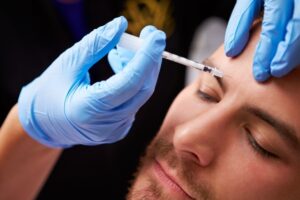
Summer is when patients want to look their best and spend the most time outdoors doing it. Also this season, we hear the same question on repeat at Center for Beauty: “Is the heat going to ruin my Botox?” Is sweat wrecking my skincare?”
A fair question. You’ve invested real time and money into your results. You deserve a straight answer grounded in clinical evidence, not internet rumor. Here’s what actually protects that investment through the hottest months of the year.
The Heat Myth: Does Summer Sun Truly “Melt” Your Botox?
If you’ve searched ‘Botox in summer’ and landed on conflicting advice, you’re not alone. One of the most common questions we hear this time of year. Short answer: no, not the way social media suggests.
Once Botox has fully bound to its target receptors, a process that completes over roughly the first two weeks after injection, ambient temperature has no meaningful effect on how it works. Everyday summer heat, pool time, and sweating do not “melt” or dissolve neuromodulators that have already settled into the muscle.
Where heat does matter is in a narrow window immediately after treatment. In the first 24 to 48 hours, high heat increases blood flow to the treated area. That extra circulation can worsen swelling and bruising, and in theory may encourage the product to migrate before it has fully bound, slightly affecting precision of results. This is a timing issue, not a summer-long issue.
The practical takeaway: treat the first two days after any injectable appointment as a “keep it cool” window. After that, live your summer normally. If anything, many providers see summer as a great time for injectables. Patients already focus on skin health and sun protection.
The Sunscreen Synergy: Why Vitamin C + SPF Are Non-Negotiable
This is the part of the summer conversation that deserves far more attention than the heat myth, because UV exposure is the one summer factor that genuinely undermines your results, particularly if you’ve invested in collagen-building treatments like Morpheus8 or microneedling.
Here’s the mechanism: ultraviolet radiation increases an enzyme called MMP-1 in the skin, which actively breaks down collagen. That’s true for the collagen you’re born with, and it’s true for the new collagen your provider just worked to stimulate. Unprotected sun exposure after a resurfacing or microneedling treatment can quietly erode the results you invested in.
This is where topical Vitamin C earns its reputation as a non-negotiable, not a nice-to-have. Vitamin C isn’t a sunscreen, but it works as an antioxidant that neutralizes the free radicals UV exposure generates, and it supports the enzymes responsible for producing new collagen. Applied correctly, it meaningfully extends the protective and rebuilding effects of your skincare and procedures. The order matters: Vitamin C serum first, in the morning, followed by moisturizer, followed by sunscreen.
For the sunscreen itself, follow the standard both the FDA and the American Academy of Dermatology (AAD) recommend: a broad-spectrum formula (protects against both UVA and UVB), SPF 30 or higher, reapplied roughly every two hours outdoors and after swimming or heavy sweating. Physician-dispensed options like Avène or Glytone are formulated to be gentle on freshly treated, post-procedure skin while still meeting that broad-spectrum standard. Choosing a medical-grade sunscreen over an over-the-counter alternative isn’t just a preference; it’s a meaningful difference in formulation quality when your skin is actively healing or rebuilding collagen.
The rule of thumb: if you’ve had Morpheus8, microneedling, or any collagen-stimulating treatment this summer, medical-grade Vitamin C and SPF aren’t optional extras, they’re what makes sure the treatment actually holds.
The Travel-Ready Routine: Packing a Physician-Directed Regimen
Vacation is exactly when routines fall apart and exactly when your skin needs the most consistent protection, given more sun exposure, more time outdoors, and more disrupted sleep and hydration. A few practical rules:
- Carry it on, don’t check it. Cargo holds and hot cars can reach temperatures that degrade active ingredients like Vitamin C and retinoids. Keep your actives in your carry-on, not checked luggage.
- Decant, don’t skip. Travel-size containers (within TSA’s 3-1-1 liquid limits) let you bring your full physician-directed lineup without hauling full bottles.
- Don’t improvise with hotel or drugstore products. If your regimen was built around medical-grade formulations, swapping in an unfamiliar product mid-trip is the fastest way to trigger irritation or breakouts on sensitized skin.
- Respect peak UV hours. The FDA flags 10 a.m. to 2–4 p.m. as the window of most intense UV exposure. Pair sunscreen with a wide-brimmed hat and UV-blocking sunglasses when you’re out during that stretch.
- Reapply on a schedule, not a memory. Set a phone reminder for SPF reapplication every two hours while you’re active outdoors, it’s easy to lose track of time on vacation.
Quick-Answer FAQ
Does hot weather make Botox wear off faster? No, once fully bound (about two weeks post-injection), ambient heat does not affect how long Botox lasts. The only heat-sensitive window is the first 24–48 hours after treatment.
Can I still get Morpheus8 or microneedling during the summer? Yes, as long as you commit to strict sun protection afterward. UV exposure breaks down collagen through the MMP-1 pathway, so summer treatments require more diligent SPF and Vitamin C use, not avoidance of treatment altogether.
What’s the correct order for Vitamin C and sunscreen? Vitamin C serum first (morning), then moisturizer, then sunscreen. Vitamin C is not a sunscreen substitute. The two work together, not in place of each other.
What SPF should I actually be using? Broad-spectrum, SPF 30 or higher, reapplied every two hours outdoors or after swimming/sweating.
Protect What You’ve Invested In
Your results are the product of expertise, precision, and your own commitment to aftercare. The good news: protecting that investment through summer isn’t complicated. It comes down to two things; respecting a short post-treatment window around heat, and treating sun protection as a daily, non-negotiable habit rather than an afterthought.
If you have questions about your specific treatment plan, your current skincare regimen, or how to time your next appointment around summer travel, our team at Center for Beauty is here to help you build a routine that holds up all season long.

